
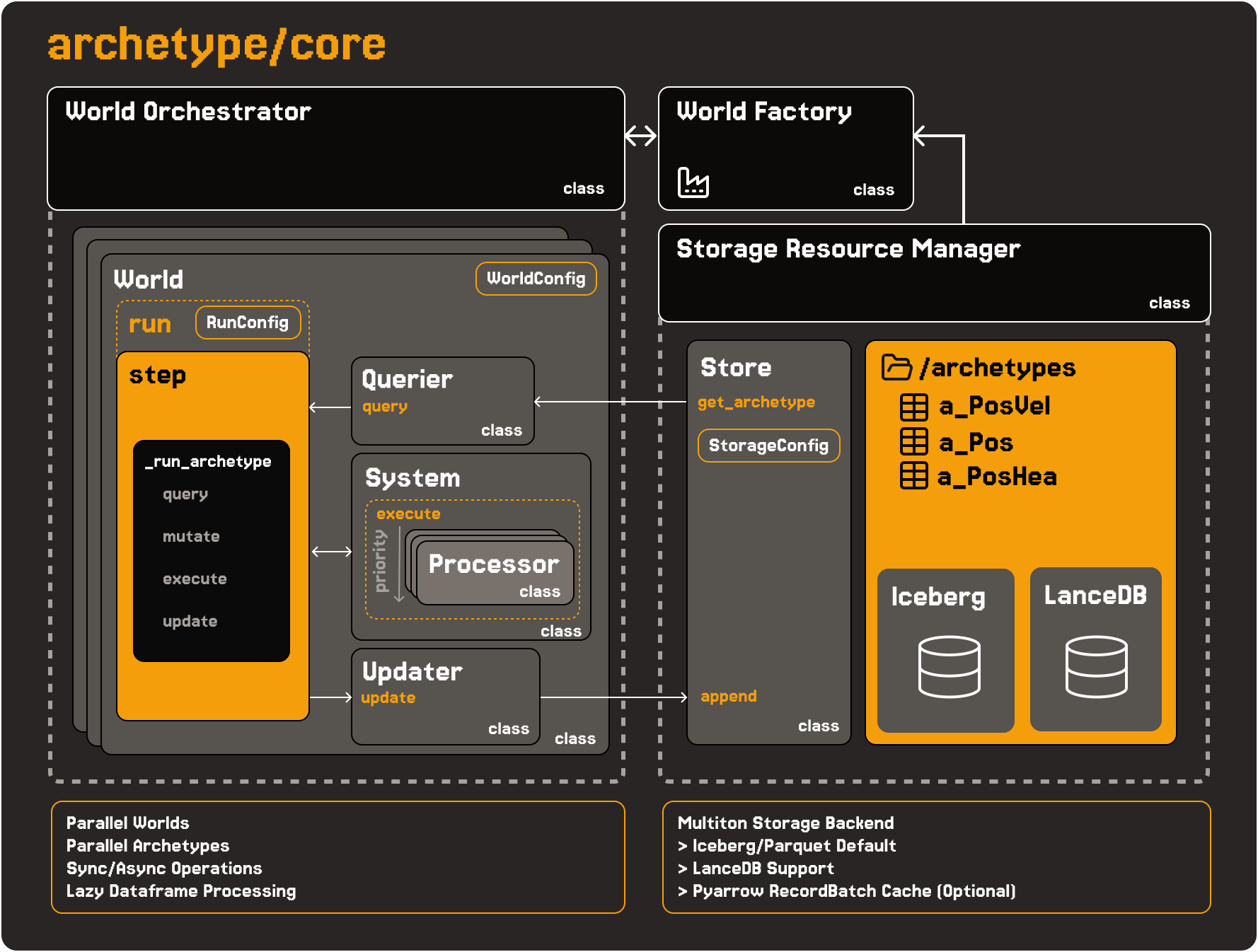
Archetype is a data-centric Entity-Component-System simulation engine. World state is stored as columnar DataFrames, and each tick appends new rows instead of overwriting previous state. That storage model supports time-travel queries, forking, replay, and audit.
Layers
archetype.api / cli          REST API and thin HTTP client
       |
archetype.runtime            ArchetypeRuntime, RuntimeWorld
       |
archetype.app                ServiceContainer, iCommandService, audit, broker
       |
archetype.core               AsyncWorld, AsyncProcessor, Resources, Storage
ArchetypeRuntime is the recommended script boundary. It owns a ServiceContainer, returns lazy world handles, binds each handle to an ActorCtx, and forwards every operation through iCommandService.
from archetype import ArchetypeRuntime, Component


class Position(Component):
    x: float = 0.0
    y: float = 0.0


async with ArchetypeRuntime() as runtime:
    world = runtime.world("demo")
    entity_id = await world.spawn(Position(x=0, y=0))
    await world.run(steps=10)
Drop to ServiceContainer for lower-level hosting, explicit command routing, or tests that need direct service access.
Command Gate
All external operations flow through iCommandService, the policy enforcement point.
Runtime / API / caller
  -> iCommandService
  -> guardrail_allow
  -> delegate to one service
  -> iAuditLog.record
  -> return result
The broker is only the queue for tick-deferred commands. It is not the authorization boundary and it is not the audit log.
Roles
Roles are flat:
| Role | Intent |
|---|---|
viewer |
Read-only operations |
player |
Entity participation: spawn, despawn, update, message, custom |
operator |
Schema, processors, hooks, resources, simulation control, fork, destroy |
admin |
All commands, including world creation |
To combine capabilities, give an actor multiple roles. operator is not implicitly viewer unless both roles are present in the actor context.
See Command Gate.
Execution
The simulation hierarchy is:
step     one tick
run      N steps, no termination, no fork
episode  step until termination/cap on the supplied world
rollout  N forked episodes from a base world
See Execution Hierarchy.
Tick Lifecycle
A tick has two service-level phases:
SimulationService.step(world_id, run_config)
  |
  1. CommandService.drain_and_apply(world_id, tick)
  |    CommandBroker.dequeue_due(world_id, tick)
  |    MutationService / WorldService applies due commands
  |
  2. AsyncWorld.step(run_config)
       |
       a. Query previous state
       b. Materialize pending structural mutations
       c. Execute matching processors
       d. Persist appended rows
       e. Refresh live state and hooks
Processors are trusted internal code once registered. External callers do not bypass the gate.
World Lifecycle
World lifecycle has three operations:
create_world: admin-only identity creation.fork_world: create a new world from the source snapshot.destroy_world: remove the live in-memory world; storage and audit rows remain.
Forks receive a new world_id, a new run_id, the source tick, copied pending mutation caches, copied hook registrations, and shared processor/resource instances by default.
See World Lifecycle.
Deep Dives
Specifications
Core
- Archetype
- Components
- Processors
- Systems
- Worlds
- Lifecycle Hooks
- Resources
- Stores
- Querier
- Updater
- Configuration