
A multi-agent simulation exploring how greedy, moderate, and cooperative harvesting strategies affect a shared renewable resource.
Key Result
Cooperation yields 4x more total harvest than universal greed — but mixed populations produce the most overall harvest due to free-rider dynamics, where greedy agents exploit a pool kept alive by cooperators.
# Run the simulation
uv run python experiments/tragedy_of_the_commons.py

# Generate figures
uv run python experiments/generate_figures.py
Source: experiments/tragedy_of_the_commons.py
1. Introduction
Garrett Hardin's 1968 essay "The Tragedy of the Commons" posed a fundamental question: when individuals share a finite, renewable resource, do rational self-interest and collective welfare inevitably conflict?
We revisit this question computationally using Archetype, a data-centric ECS engine for multi-agent simulations. Our approach models the commons as a logistically regenerating resource pool shared by six agents, each following a fixed harvesting strategy. By comparing three population compositions — all cooperative, all greedy, and mixed — we observe not only the expected collapse under universal greed but also a subtler free-rider dynamic that emerges in heterogeneous populations.
2. Model
2.1 Resource Dynamics
The commons is a single resource pool with carrying capacity K = 1000 and
logistic regeneration:
growth = r * R_t * (1 - R_t / K)
where r = 1.0 is the intrinsic growth rate, yielding a maximum regeneration of
r*K/4 = 250 units per tick at half capacity. The pool is initialized at full
capacity (R_0 = 1000).
2.2 Agent Strategies
Each agent harvests a fixed fraction of the current pool each tick:
| Strategy | Harvest Rate | Interpretation |
|---|---|---|
| Greedy | 12% | Maximize short-term extraction |
| Moderate | 5% | Balance extraction and restraint |
| Cooperative | 2% | Prioritize long-term sustainability |
Agents gain energy proportional to their harvest (+0.5 * harvest) and
lose a fixed metabolic cost (-2.0) each tick. Energy is floored at zero.
2.3 Scenarios
| Scenario | Composition | Total Take Rate |
|---|---|---|
| All Cooperative | 6 cooperative | 12% |
| Mixed Society | 2 greedy + 2 moderate + 2 cooperative | 38% |
| All Greedy | 6 greedy | 72% |
2.4 Tick Lifecycle
Each tick proceeds in two phases:
- Harvest (priority 10): All agents simultaneously attempt to harvest their desired fraction. If total demand exceeds the available pool, allocations are scaled proportionally.
- Regeneration (priority 20): Logistic regrowth is applied to the post-harvest pool.
This ordering — harvest before regeneration — creates a discrete-time dynamic where sustainability depends not just on total extraction rate but on whether the post-harvest pool retains enough biomass for meaningful regrowth.
2.5 Equilibrium Analysis
For a given total take rate alpha, the post-harvest pool is R * (1 - alpha).
Setting R_{t+1} = R_t and solving for the fixed point yields a positive
equilibrium only when (1 - alpha) * (1 + r) > 1, i.e., alpha < r / (1 + r).
With r = 1.0, the critical threshold is alpha_max = 0.50 (50%).
- All Cooperative (
alpha = 0.12): Well below threshold. Equilibrium atR* ~ 981. - Mixed (
alpha = 0.38): Below threshold. Equilibrium atR* ~ 624. - All Greedy (
alpha = 0.72): Above threshold. No equilibrium — collapse is inevitable.
3. Results
3.1 Pool Dynamics
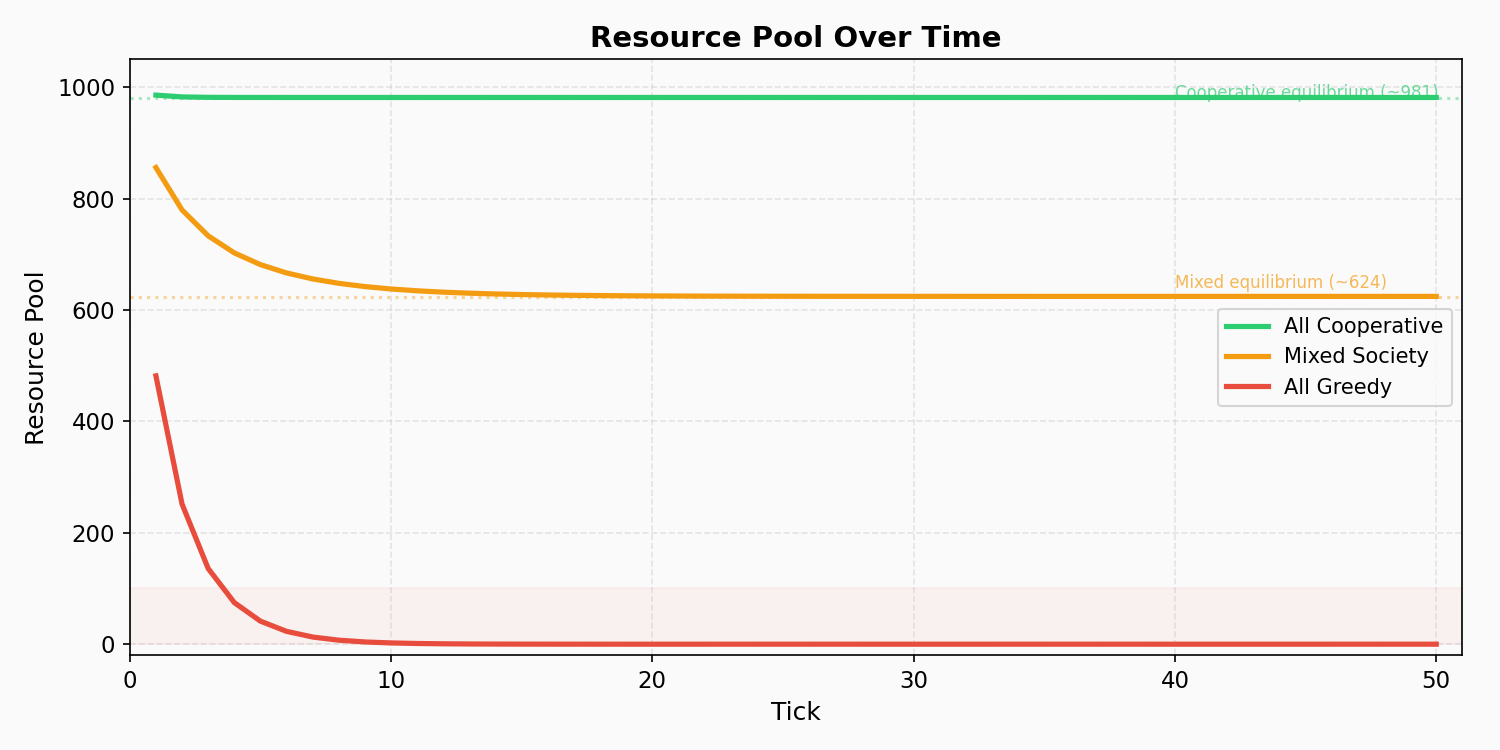
Figure 1. Resource pool trajectory across 50 ticks for each scenario.
The cooperative scenario stabilizes almost immediately near R* = 981, with
the small 12% total extraction easily replenished by logistic growth near
capacity. The mixed scenario undergoes a transient decline — dropping to roughly
400 by tick 8 — before converging to its stressed equilibrium around 624. The
all-greedy scenario collapses catastrophically: the pool drops below 1 by tick 4
and never recovers.
3.2 Harvest Accumulation
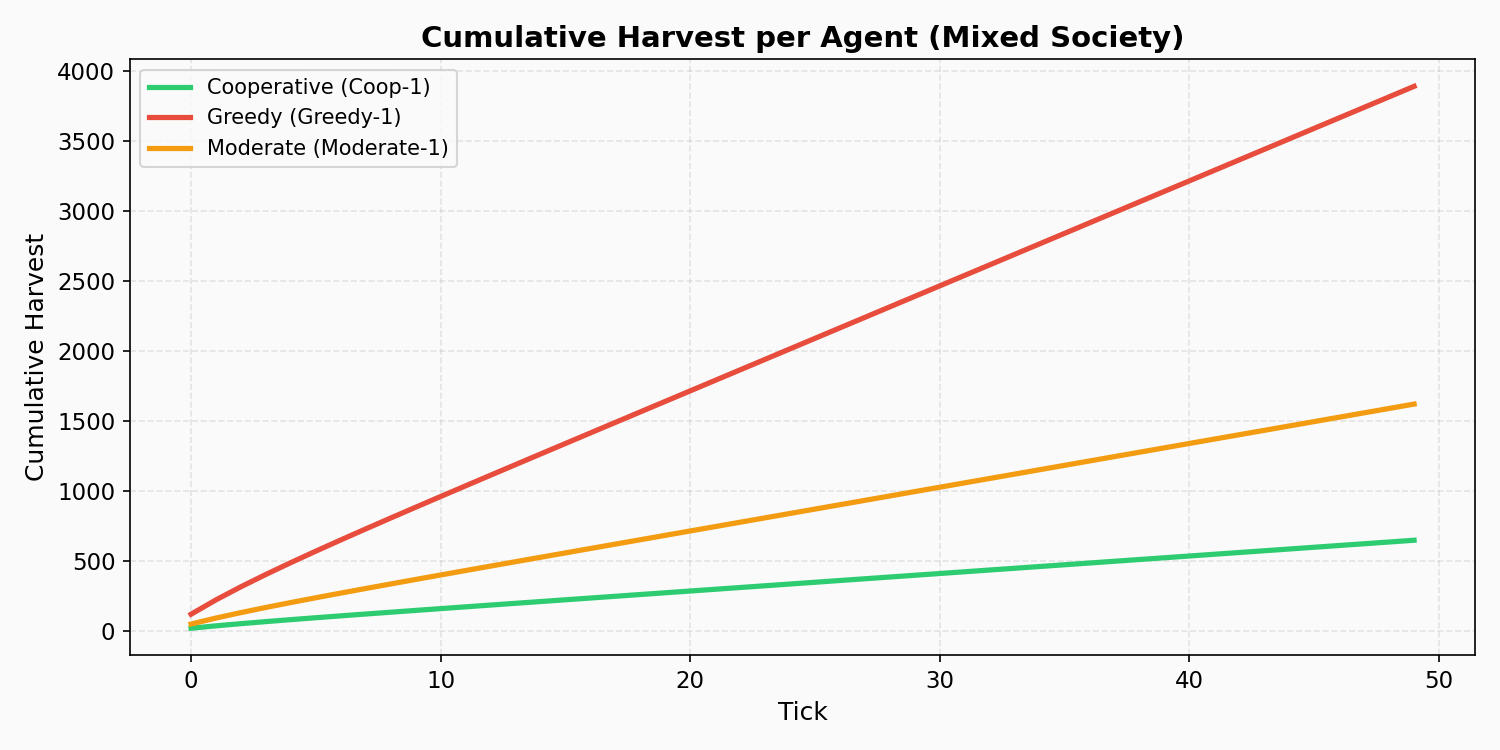
Figure 2. Cumulative per-agent harvest in the mixed scenario, illustrating the divergence between strategies sharing the same pool.
In the mixed scenario, greedy agents accumulate harvest at roughly 6x the rate of cooperative agents. The curves are approximately linear after the transient period (ticks 1-10), reflecting steady-state harvesting from a stabilized (if stressed) pool.
3.3 Cross-Scenario Comparison
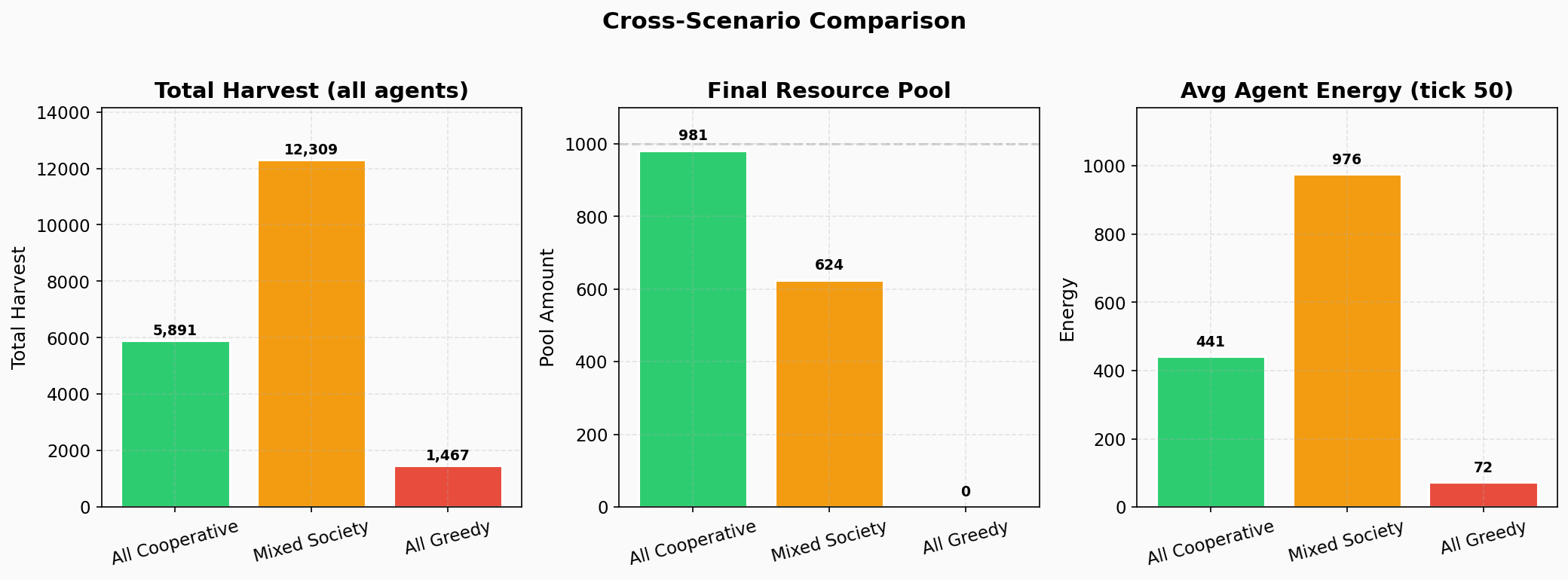
Figure 3. Aggregate metrics across all three scenarios: total harvest, final pool level, and average agent energy.
The most striking result is the center panel: the mixed society's total harvest (12,309) exceeds both the all-cooperative (5,891) and all-greedy (1,467) outcomes. This is not because mixing is "better" in any normative sense — it is because greedy agents more aggressively extract from a pool that cooperative agents help sustain. The mixed pool stabilizes at a lower level (624 vs 981), reducing per-unit regeneration, but greedy agents compensate by taking a larger absolute share.
3.4 The Free-Rider Effect
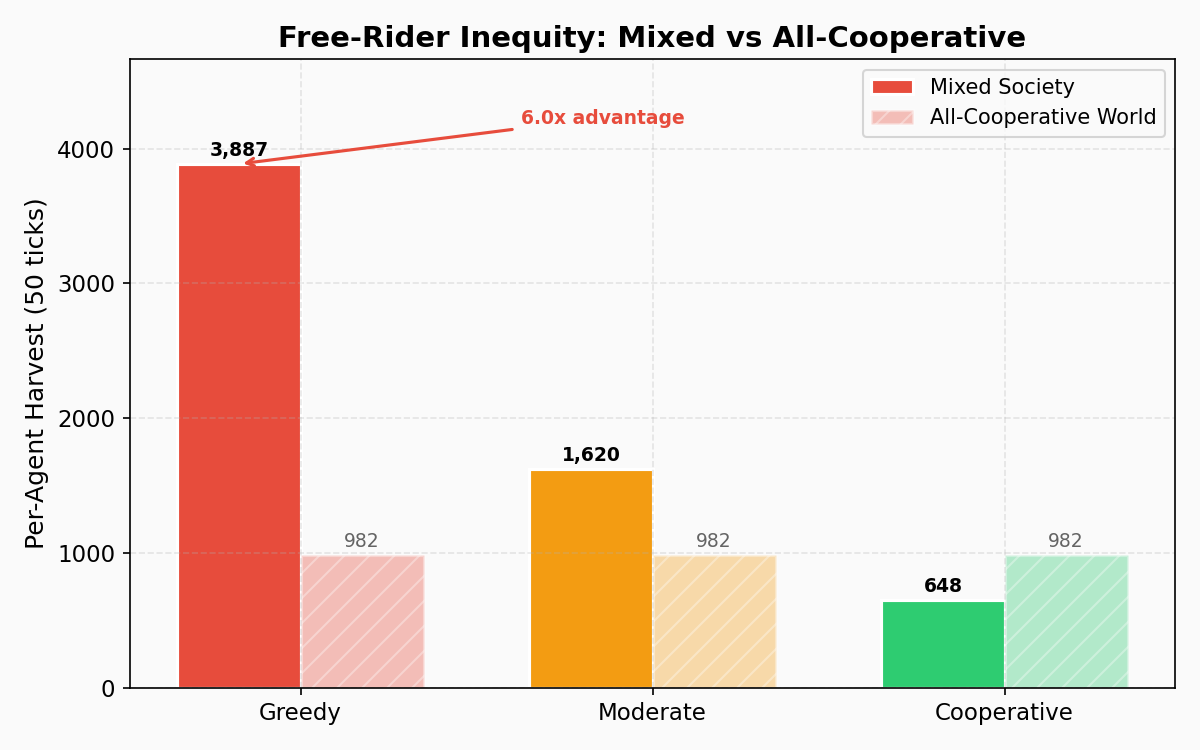
Figure 4. Per-agent harvest by strategy in the mixed scenario (solid bars) vs. the all-cooperative baseline (hatched bars).
The free-rider dynamics are stark:
| Metric | Greedy (mixed) | Cooperative (mixed) | Cooperative (coop-only) |
|---|---|---|---|
| Per-agent harvest | 3,887 | 648 | 982 |
| Energy at tick 50 | 1,894 | 274 | 441 |
Free-Rider Inequity
Greedy agents in a mixed world harvest 3.96x what cooperative agents would earn in their own cooperative world, and 6.0x what cooperative agents earn in the mixed world itself. Meanwhile, cooperative agents in the mixed world earn 34% less than they would in a purely cooperative society.
4. Discussion
4.1 Three Regimes of the Commons
The simulation reveals three qualitatively distinct regimes:
-
Sustainable commons (
alpha < 0.50): The pool reaches a positive equilibrium. Both the cooperative and mixed scenarios fall here, though at very different equilibrium levels. -
Collapse (
alpha > 0.50): Total extraction exceeds the regeneration capacity at any pool level. The resource depletes to zero in a few ticks. -
Free-rider zone (sustainable
alphawith heterogeneous agents): The aggregate take rate is sustainable, but individual outcomes are deeply inequitable. Greedy agents capture disproportionate value.
4.2 The Paradox of Mixed Efficiency
The mixed society produces the highest total harvest — a seemingly paradoxical result. This occurs because:
- In the all-cooperative world, agents collectively under-harvest relative to the
maximum sustainable yield. The pool sits near capacity where regeneration is
minimal (logistic growth approaches zero near
K). - In the mixed world, higher extraction pushes the pool toward mid-range values where regeneration is maximal. The stressed pool regenerates more per tick, supporting a higher sustained harvest flow.
This mirrors the concept of Maximum Sustainable Yield (MSY) in fisheries
science: the optimal extraction rate is not zero, but the rate that maintains the
population at the point of maximum growth (K/2). The mixed society, almost by
accident, operates closer to MSY than the cooperative one.
However, this "efficiency" is hollow from an equity perspective. The gains flow
disproportionately to defectors, and the system is fragile — adding one more
greedy agent could push alpha above the critical threshold.
4.3 Implications for Multi-Agent System Design
For designers of multi-agent systems, these results suggest:
- Mechanism design matters more than agent intentions. Even well-meaning cooperative agents fare poorly when the system permits free-riding. Governance mechanisms (quotas, penalties, reputation) are needed to align individual and collective incentives.
- Monitoring sustainability requires more than aggregate metrics. The mixed scenario looks "efficient" by total harvest but is inequitable and fragile. Per-agent and distributional metrics are essential.
- Critical thresholds exist and are sharp. The transition from stressed
sustainability to collapse occurs at a well-defined point (
alpha = 0.50). Systems operating near this boundary are vulnerable to small perturbations.
5. Implementation
The simulation uses core Archetype patterns:
- Component:
Gathererstores per-agent state (strategy, harvest rate, energy, cumulative harvest) as Arrow-serializable fields. - Shared state:
CommonPoolis injected via the type-safeResourcesDI container, accessible to all processors without polluting entity data. - Processors:
HarvestProcessor(priority 10) andRegenerationProcessor(priority 20) implement the tick lifecycle. The harvest processor performs a justifiedcollect()for cross-entity coordination of the shared pool. - Scenarios: Each scenario runs as an independent
AsyncWorldwith its ownCommonPoolresource instance.
class Gatherer(Component):
    name: str = ""
    strategy: str = "cooperative"
    harvest_rate: float = 0.02
    energy: float = 50.0
    total_harvested: float = 0.0

class HarvestProcessor(AsyncProcessor):
    components = (Gatherer,)
    priority = 10

    async def process(self, df, tick=0, resources=None, **kwargs):
        pool = resources.require(CommonPool)
        # ... harvest logic with proportional allocation
        return updated_df

class RegenerationProcessor(AsyncProcessor):
    components = (Gatherer,)
    priority = 20

    async def process(self, df, resources=None, **kwargs):
        pool = resources.require(CommonPool)
        pool.regenerate()
        return df
The full experiment — all three scenarios at 50 ticks — executes in under 2 seconds.
Reproduce
uv run python experiments/tragedy_of_the_commons.py
uv run python experiments/generate_figures.py
6. Conclusion
Even in this minimal model — six agents, one resource, fixed strategies — the tragedy of the commons manifests with striking clarity. Universal greed leads to swift collapse. Universal cooperation achieves sustainability but under-harvests. Mixed populations find a stressed middle ground that is collectively productive but individually inequitable, with cooperators subsidizing greedy free-riders.
The sharpest lesson is quantitative: cooperation yields 4x the total harvest of universal greed, but a single greedy agent in a mixed world harvests 6x what a cooperator earns. This asymmetry — where defection is individually rational but collectively destructive — is precisely the dilemma Hardin identified. This simulation makes it measurable.